
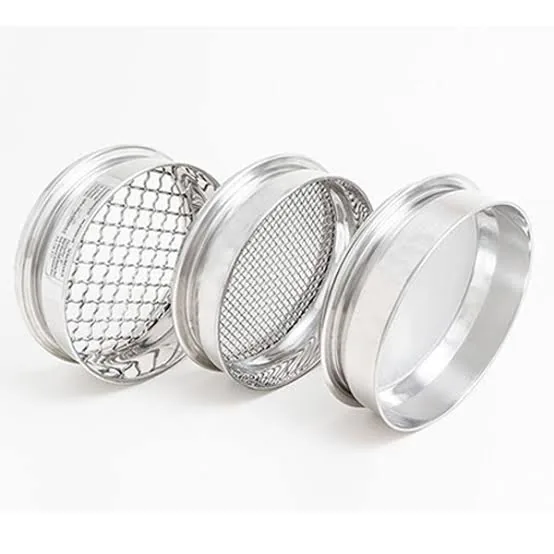
Key Features of the Working Sieves
- Standard ASTM E11 and ISO 3310-1 aperture sizes
- Sturdy stainless steel or brass frames for daily use
- Full height and half height options
- Compatible with all common sieve shakers
- Cost effective replacement for worn sieves
Working Sieves Technical Specifications
| Parameter | Value |
|---|---|
| Aperture range | 25 µm to 4.75 mm |
| Frame material | Stainless steel or brass |
| Mesh material | Stainless steel or brass |
| Frame diameters | 200 mm and 300 mm standard, others on request |
| Use | Routine and production testing |
| ASTM E11 Sieve No. | Aperture (mm) | Aperture (µm) |
|---|---|---|
| 4 | 4.75 | 4750 |
| 5 | 4.00 | 4000 |
| 6 | 3.35 | 3350 |
| 7 | 2.80 | 2800 |
| 8 | 2.36 | 2360 |
| 10 | 2.00 | 2000 |
| 12 | 1.70 | 1700 |
| 14 | 1.40 | 1400 |
| 16 | 1.18 | 1180 |
| 18 | 1.00 | 1000 |
| 20 | 0.850 | 850 |
| 25 | 0.710 | 710 |
| 30 | 0.600 | 600 |
| 35 | 0.500 | 500 |
| 40 | 0.425 | 425 |
| 45 | 0.355 | 355 |
| 50 | 0.300 | 300 |
| 60 | 0.250 | 250 |
| 70 | 0.212 | 212 |
| 80 | 0.180 | 180 |
| 100 | 0.150 | 150 |
| 120 | 0.125 | 125 |
| 140 | 0.106 | 106 |
| 170 | 0.090 | 90 |
| 200 | 0.075 | 75 |
| 230 | 0.063 | 63 |
| 270 | 0.053 | 53 |
| 325 | 0.045 | 45 |
| 400 | 0.038 | 38 |
| 450 | 0.032 | 32 |
| 500 | 0.025 | 25 |
Specifications can vary by model and configuration. The final specification is confirmed in your quotation.
Applications
- Production line quality checks
- Aggregate and sand plants
- Food and spice grading
- Pharmaceutical in-process checks
- Teaching laboratories
Standards and Compliance
Working sieves use the same aperture series as ASTM E11 and ISO 3310-1. Compare them regularly with a certified or calibrated master set to confirm they are still accurate.
How to Choose the Right Working Sieves
Choose working sieves for high volume daily testing. Keep a Certified or Calibrated set as a reference, and replace working sieves when the comparison shows drift or the mesh is damaged.
Frequently Asked Questions
What are working sieves?
Working sieves are standard test sieves used for routine particle size checks. They are made to the same aperture series as certified sieves but are intended for frequent daily use, so the laboratory can keep its certified or calibrated sieves as a protected reference set.
How long do working sieves last?
Life depends on sample hardness, load and cleaning. Fine mesh used on abrasive materials such as sand or slag wears faster than mesh used on flour or plastics. Inspect the mesh regularly and replace the sieve when you see stretching, holes or a shift against your reference set.
How should I clean working sieves?
Brush gently from the underside with a soft sieve brush, or use an ultrasonic cleaner for fine mesh. Avoid pushing particles through the mesh with hard tools. Dry stainless steel and brass sieves fully before storage to prevent corrosion and clogging.
What is the price of Working Sieves in India?
The Working Sieves price depends on the model, size, configuration and accessories you choose, so Laboteck quotes each requirement individually instead of publishing a fixed price list. Send your requirement through the quote form or WhatsApp and you will receive a quotation in INR with GST, delivery time and warranty terms.
Do you export working sieves?
Yes. Laboteck supplies working sieves to laboratories across India and exports to buyers worldwide. Share the model or size you need, quantity, power supply and destination country, and our team will reply with a quote in INR or USD, delivery time and shipping options.