
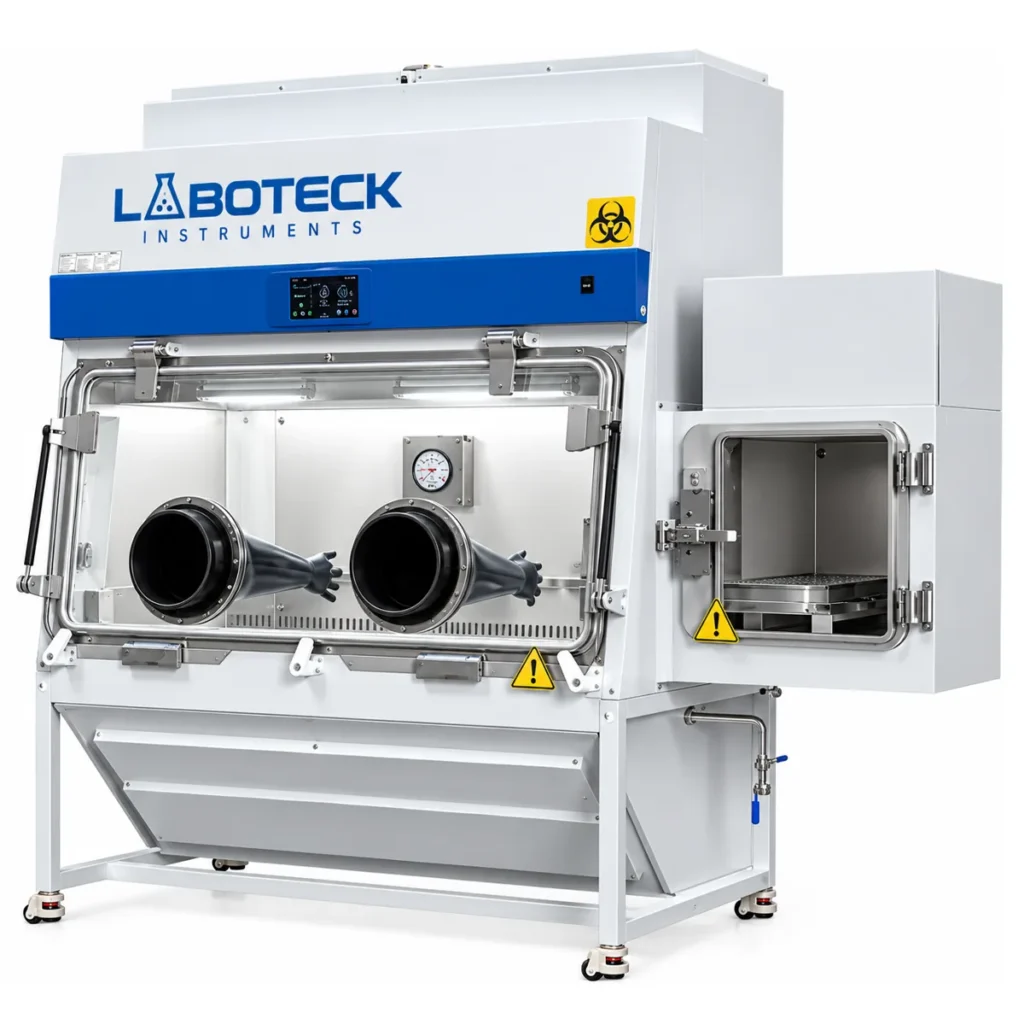
Key Features of the Biosafety Cabinet
- Five widths from 2 ft to 6 ft
- Floor standing and benchtop versions
- SS 304 or powder coated MS construction
- Washable pre filters plus HEPA filtration
- Magnehelic gauge for filter pressure
- Illumination above 900 lux and noise below 65 dB
Biosafety Cabinet Technical Specifications
| Model Number | Bios -2 | Bios -3 | Bios -4 | Bios -5 | Bios -6 |
|---|---|---|---|---|---|
| Nominal Size | 2 ft. | 3 ft. | 4 ft. | 5 ft. | 6 ft. |
| Working area (ft.) | 2 x 2 x 2 | 3 x 2 x 2 | 4 x 2 x 2 | 5 x 2 x 2 | 6 x 2 x 2 |
| External size (ft.) | 2 x 3 x 7 | 3 x 3 x 7 | 4 x 3 x 7 | 5 x 3 x 7 | 6 x 3 x 7 |
| Benchtop Models (ft.) | 2 x 3 x 4 | 3 x 3 x 4 | 4 x 3 x 4 | 5 x 3 x 4 | 6 x 3 x 4 |
| Cabinet construction | SS 304 / MS powder Coated |
|---|---|
| Cleanliness class | ISO class 3 |
| Operating Temperature | 5 – 60 degrees Celsius |
| Operating relative humidity | 30-95% Relative Humidity |
| Atmospheric pressure | 120 Pascal’s |
| Illumination level | >900 Lux |
| Noise pressure | <65 decibel |
| Air supply filter | Pre-Filters are Washable |
| Differential pressure Indicating a range | 0 to 500 Pa manometer |
| Differential pressure indicating the precision | + 1% |
| Power Requirements | 500 watts |
Specifications can vary by model and configuration. The final specification is confirmed in your quotation.
Applications
- Microbiology and virology labs
- Hospital and diagnostic labs
- Cell culture and tissue culture
- Pharmaceutical QC
- Research institutes
Standards and Compliance
Select the cabinet class to match the biosafety level of your work. Cabinets should be tested for airflow and filter integrity after installation and at regular intervals.
How to Choose the Right Biosafety Cabinet
Choose the width by how many people work at once and the size of your equipment. A 4 ft cabinet suits most single user labs.
Frequently Asked Questions
What is a biosafety cabinet used for?
A biosafety cabinet is used to handle infectious agents, cell cultures and other biological materials safely. HEPA filtered airflow protects the operator from aerosols, protects the sample from contamination and cleans the exhaust air before it leaves the cabinet.
What is the difference between a biosafety cabinet and a laminar air flow?
A laminar air flow cabinet only protects the sample by blowing clean air over it, often towards the user. A biosafety cabinet protects the user, the sample and the environment, so it is required when working with infectious or hazardous biological material.
Which biosafety cabinet class do I need?
Class II cabinets are the most common and suit most clinical, microbiology and cell culture work. Class III cabinets are fully sealed glove boxes for the highest risk agents. Tell us your organisms and biosafety level and we will recommend a model.
What is the price of Biosafety Cabinet in India?
The Biosafety Cabinet price depends on the model, size, configuration and accessories you choose, so Laboteck quotes each requirement individually instead of publishing a fixed price list. Send your requirement through the quote form or WhatsApp and you will receive a quotation in INR with GST, delivery time and warranty terms.
Do you export biosafety cabinets?
Yes. Laboteck supplies biosafety cabinets to laboratories across India and exports to buyers worldwide. Share the model or size you need, quantity, power supply and destination country, and our team will reply with a quote in INR or USD, delivery time and shipping options.